Text beats coordinates indoors
Level, block, and row are stored as what you typed. They do not degrade with signal, and they match the signs on the walls.
Find your car in a parking garage
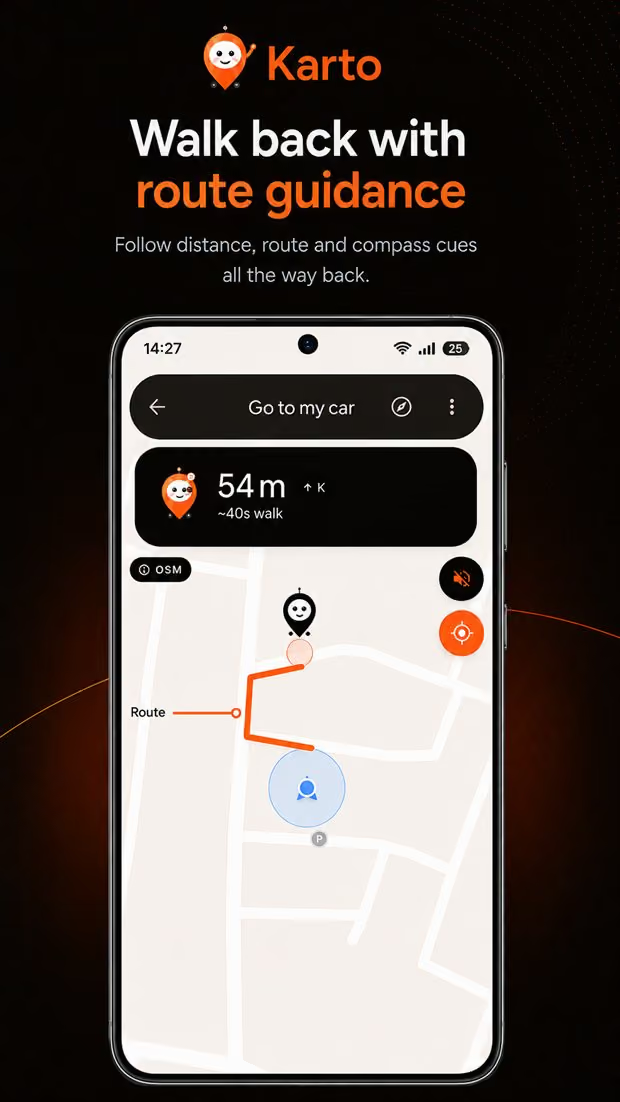
Multi-storey garages are the one place a map pin cannot solve on its own. Karto keeps the level, block, row, and a photo alongside the location, and switches to a compass when the signal disappears.
Problem and solution
A parking garage defeats satellite positioning by design. Concrete floors and steel reinforcement block the signal, so as you drive down the ramp your phone loses its fix and holds on to the last position where it could still see open sky — usually the entrance, sometimes the street outside. Save a spot there and the pin is honest about the building but useless about the space.
The second problem is that garages repeat themselves. Level two looks like level three. Block C looks like block D. The visual memory people normally rely on outdoors has almost nothing to grip, and after two hours in a shopping centre or a full day at an airport there is nothing left of it at all.
The third is scale. An airport car park can hold several thousand spaces across multiple buildings connected by walkways. Being twenty metres out is not a rounding error there; it is a different aisle, and possibly a different floor.
None of this is fixable by making a map more accurate. It is fixed by storing the information the building is actually organised around.
Step by step
The first three steps take seconds on the way out. The last one is for when it is already too late.
Save the spot while you are still next to the car. If you wait until you are inside the mall, the phone has already moved and the record loses its meaning.
These two fields are the ones that actually bring you back. Garages sign them on pillars and near the lifts; type them exactly as they are written.
The nearest pillar number, bay marking, or lift entrance. One photo replaces several minutes of walking down the wrong aisle.
Go to the level and block first, then let the compass point you along the aisle. The map is the least useful of the three indoors, so Karto does not lead with it.
With Karto
These are not general features. Each one exists because of what a garage does to a phone.
Level, block, and row are stored as what you typed. They do not degrade with signal, and they match the signs on the walls.
Where a route line would be fiction, Karto shows a bearing and a distance. It is less precise and much more honest.
The record is written on the device. No data connection is needed either to save the spot or to read it back.
Opened alongside the directions, not buried in your camera roll, so the recognition step happens where you need it.
If someone else is fetching the car, they get the level, block, and photo, not just a pin on a building.
Garage tariffs step up sharply after each hour. Save the time and Karto reminds you before the next step.
An honest note on limits
No app can give you reliable indoor positioning with a normal phone, and any that claims to is overselling. What can be improved is everything around the coordinate.
Frequently asked
GPS needs a line of sight to satellites. Inside a garage that line is blocked, so the phone keeps the last position it was confident about — usually the entrance ramp or the street outside.
Not reliably. Some vehicles report their own position through the manufacturer app. Without that, an app can only show you a spot you recorded yourself.
The level and the block. Those two alone reduce a multi-storey garage to a single floor and a single section, which is usually enough.
Yes. Saving and reading a spot both work offline; the record syncs later when you have a connection again.
Usually, yes. A route line implies a precision that does not exist indoors, while a bearing and a distance degrade more gracefully.
Related solutions
Get Karto
Level, block, one photo. Thirty seconds at the car turns the walk back into a straight line.